



No. Termites do not die in winter in Georgia. Subterranean termites, the kind found under North Atlanta homes, move deeper into the soil when the surface gets cold, and a colony that has already reached a heated house can keep feeding straight through January. What stops in winter is the swarming, and swarmers are the only part of a colony most homeowners ever see. That is why a quiet winter tells you very little about whether your house has termites.
This guide uses the University of Georgia’s own termite bulletin to explain what cold weather does to a colony, why the swarm calendar misleads people, and what you can check for yourself between now and spring.
What Cold Weather Does to a Termite Colony
UGA Extension’s bulletin on the biology of subterranean termites puts it plainly: temperature has a strong influence on daily and seasonal termite activity. Termites will not forage when the topsoil is too hot or too cold. They adjust by moving, and the bulletin says they migrate deeper in the soil when surface temperatures are unsuitable.
So a cold snap changes where termites are working. It does not empty the colony. The same bulletin lists “an overlapping of generations”, with eggs laid year-round, as one of the traits of termite societies. There is no winter die-off followed by a fresh start in spring. The colony under your yard in February is the same colony that was there in October.
The bulletin does say that in climates where winters are extremely cold, foraging is limited by frozen or nearly frozen topsoil. North Atlanta is not that kind of climate. Acworth, Kennesaw and Woodstock get hard freezes on some nights, but that is a long way from ground that stays frozen for months.
Why a Heated House Keeps Termites Working
Here is the sentence from the UGA bulletin that matters most for a homeowner: “Termites most likely remain active in cold weather if the structure they are infesting is heated.”
Think about what a house offers in January. The soil under a slab or beside a heated basement wall stays warmer than the open yard. The wood above it is sheltered from wind and frost. UGA describes warm, moist wood as providing subterranean termites with all of their survival requirements. A colony that found its way into a sill plate or a floor joist last summer has no reason to leave when the weather turns.
The researchers are honest about the limits of what is known. The bulletin says little is known about termite foraging behavior during the winter. What it does not say is that termites stop. For a house that is heated all season, the safe assumption is that feeding continues.
Swarmers Are the Wrong Thing to Count
Most people judge termite risk by one event: winged termites coming out of a wall or a stump on a warm spring day. When that doesn’t happen, they assume all is well. The trouble is that swarming is a short, seasonal event, and each species has its own months.
| Native subterranean termite | Typical swarm months | What the swarmers look like |
|---|---|---|
| Eastern subterranean termite | February through April | Brownish black to black |
| Dark southeastern subterranean termite | April through June | Brownish black to black |
| Light southeastern subterranean termite | July through September | Yellowish brown |
Source: UGA Extension Bulletin 1209, Biology of Subterranean Termites in the Eastern United States.
Three facts from the same bulletin explain why a missing swarm proves nothing:
- Usually only mature colonies swarm. A younger colony can feed on a house without ever sending out a single winged termite.
- Swarming happens mainly when outdoor temperatures are warm. From late fall through midwinter, the calendar is simply closed.
- The swarmers are not the ones eating the wood. Workers are. They are white, wingless and blind, they are the most numerous caste, and they stay hidden inside soil, mud tubes and wood.
Winter is also when next year’s swarm is being made. UGA notes that large numbers of nymphs, the stage that becomes winged adults, are produced on a seasonal basis, usually starting in late summer, and that they take several months of molting to finish developing. A colony that looks silent in December may be getting ready for March.
One exception is worth knowing. The bulletin says termites may swarm during the winter in warm sections of an infested structure, although this is not common. If you see winged insects indoors in January, near a furnace closet, a water heater or a sunny window, don’t write them off as something that wandered in.
Winter Termite Signs You Can Check Yourself
Because the workers stay hidden, you are looking for what they leave behind. None of these signs depends on the season.
- Mud tubes. Subterranean termites build earthen runways, which UGA calls shelter tubes, to protect themselves from dry air and from ants. Look for narrow lines of dried mud running up foundation walls, piers, the inside of a crawl space or the edge of a garage slab.
- Shed wings. Swarmers drop their wings soon after they fly. UGA lists shed wings on a window sill as a sign of infestation. Wings left over from last spring still count, so check sills in the basement and behind furniture.
- Wood that is hollow along the grain. Termites feed along the grain and follow the softer wood, and they conceal their workings. A baseboard, door frame or sill that sounds hollow when tapped, or gives way under a screwdriver, deserves a closer look.
- Winged insects indoors. A winged termite has straight, beaded antennae, no narrow waist and two pairs of wings of equal size. A winged ant has elbowed antennae, a pinched waist and front wings larger than the hind pair.
If you break open a mud tube and see small white insects, those are workers and the tube is active. An empty tube doesn’t clear the house. It may be an old route, and the colony may be using another one.
Moisture Decides Where Termites Go
Cold gets the attention, but UGA calls moisture the most important factor limiting subterranean termite activity. Termites are thin-skinned and dry out quickly, so they need a constant supply of water. That makes a Georgia winter, with its long wet spells, a useful time to walk the house and find where water is collecting.
The bulletin names the moisture sources that can even let a colony live above ground without soil contact:
- Stopped-up gutters
- Water trapped behind siding or veneer
- Leaky plumbing or air conditioning units
- Water pooled on the roof
Add two more checks at ground level: any place where wood touches soil, such as deck posts, fence panels fixed to the house or siding that runs down into mulch, and any damp area under the house. Homes around Lake Allatoona and on the wooded, sloped lots common in Cobb and Cherokee counties can have crawl spaces that stay damp well into winter. If yours does, our page on crawl space encapsulation in Acworth explains how drying the space out works.
Why Winter Is a Sensible Time for a Termite Inspection
Nothing about a termite inspection requires warm weather. The inspector is looking for mud tubes, damaged wood, wood-to-soil contact and moisture, and all four are there year-round. Winter adds a few practical advantages:
- You find a problem before the February through April swarm season, not during it.
- Leaves are down and shrubs are thinner, so more of the foundation line is visible from outside.
- Winter rain shows you where water sits against the house.
It also helps to keep two documents apart. An inspection for your own peace of mind is different from the termite letter used in a home sale, which we cover in our guide to the Georgia termite letter. And if your home is already under a termite contract, a winter reinspection is a good moment to read what that contract promises. Our post on what a Georgia termite bond covers walks through it.
Talk to Covenant Pest Services About Termites
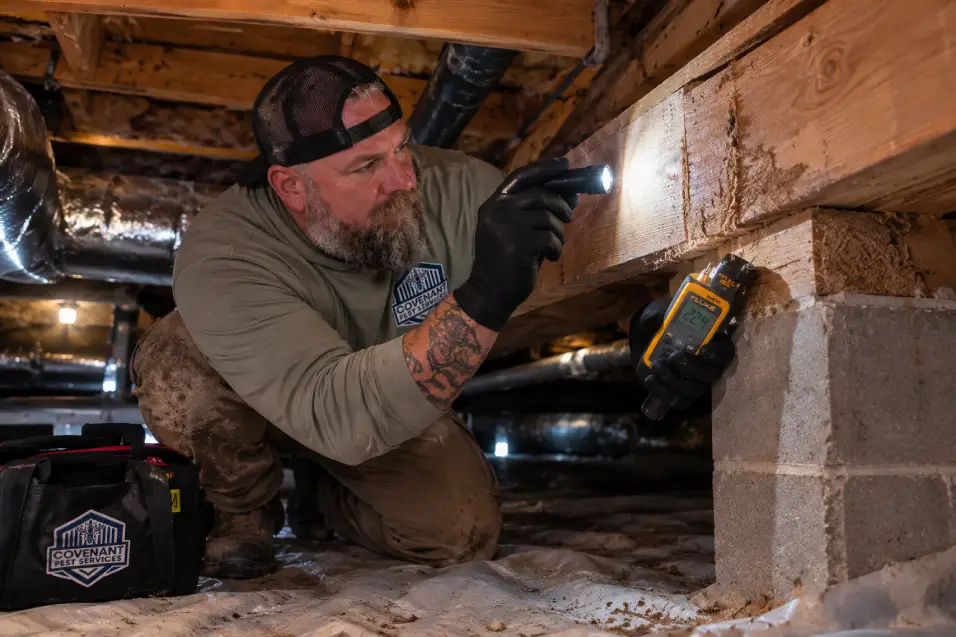
Covenant Pest Services works from our office in Acworth and serves Kennesaw, Marietta, Woodstock, Canton and the rest of North Atlanta. Our termite work starts with an inspection of the foundation, the crawl space, wood-to-soil contact points and moisture sources. Treatment options include liquid termiticide treatments and termite bait systems, and you can read about both on our termite control page.
If you have found mud tubes, shed wings or soft wood this winter, don’t wait for spring to see whether anything swarms. By the time a colony swarms, it has usually been feeding for a while.
Termites in Winter FAQ
Do termites die in winter in Georgia?
No. UGA Extension says subterranean termites migrate deeper in the soil when surface temperatures are unsuitable, and that they most likely remain active in cold weather if the structure they are infesting is heated.
Are termites active in winter?
They can be. Foraging near the cold soil surface slows down, but a colony feeding inside a heated house is protected from the cold.
When do termites swarm in Georgia?
According to UGA, the eastern subterranean termite typically swarms from February through April, the dark southeastern subterranean termite from April through June, and the light southeastern subterranean termite from July through September.
If I didn’t see swarmers this year, am I in the clear?
No. Usually only mature colonies swarm, swarms are brief, and the workers that eat wood never come out into the open. Mud tubes, shed wings and damaged wood are better evidence than swarmers.
Can termites swarm inside a house in winter?
It is uncommon, but UGA notes that termites may swarm during the winter in warm sections of an infested structure. Winged termites indoors in winter should be checked.
Does a hard freeze kill termites?
A freeze makes the topsoil unsuitable for foraging, and termites respond by moving deeper or staying inside protected wood. It does not remove a colony from a heated home.
Seeing mud tubes, shed wings or soft wood? Call (678) 820-6848 or request an estimate online.