



Scratching in the attic at night usually means mice, rats, flying squirrels or bats. University of Georgia Extension puts it simply: attic noise at night could be mice, bats or flying squirrels, while attic noise during the day could be gray squirrels. So the first clue is the clock. The second is what the animal leaves behind. The noise itself is only the symptom. The real problem is the opening the animal used to get in, and it stays open until someone finds it and closes it.
What Time You Hear It Narrows the List
Before you go up there, write down when you hear the noise for two or three nights. UGA Extension calls time of day one of the simple clues people overlook.
| When you hear it | Most likely | What to look for |
|---|---|---|
| After dark and through the night | Mice, rats, flying squirrels, bats | Droppings, gnawed holes, nests of shredded paper or cloth |
| Daytime, often early morning and late afternoon | Gray squirrels | Chewed wood at the roofline or gable |
| Overnight, with new damage in the morning | Raccoons or opossums | Torn soffit or vent, larger droppings |
| Inside a wall | Mice | Rice-sized droppings along the baseboard or in the pantry |
| In the chimney | Squirrel, raccoon, bird or bat | No chimney cap |
Source: UGA Extension Bulletin 1248, Resolving Human-Nuisance Wildlife Conflicts.
This is a starting point. Animals don’t read the chart, and more than one kind can use the same attic. An inspection is what confirms it.
Mice and Rats: The Most Common Night Noise
Three rodents live alongside people in Georgia: the house mouse, the Norway rat and the roof rat. UGA’s 2025 guide to rats and mice says they usually hide during the day and come out at night, and it lists “gnawing or scratching in the walls or attics, especially at night” as one of the signs of an infestation.
Roof rats are the ones to think about first when the sound is overhead. UGA describes them as good climbers. Norway rats are heavier and generally don’t climb, so they are more often a crawl space or ground-level problem.
Signs that point to rodents:
- Droppings. Mouse droppings are about the size of a grain of rice. Rat droppings are about the size of a raisin.
- Gnawed holes. A small hole with chewed edges is, in UGA’s words, a sure sign.
- Nests. Chewed paper or cloth in boxes, drawers or insulation.
- Smell. A musty, urine-like odor more often means mice than rats.
UGA also gives a simple test. Scatter a little baking flour or talcum powder along the attic floor near a wall, set a cracker with peanut butter in the middle and check for tracks the next morning.
If the signs match, our rat and mouse control page explains what comes next.
Flying Squirrels and Gray Squirrels Keep Different Hours
Many North Atlanta homeowners assume a squirrel problem means daytime noise. That’s true for gray squirrels. Flying squirrels are the exception. They are active at night, which is why UGA Extension lists them next to mice and bats for nighttime attic noise.
That matters in neighborhoods with mature hardwoods, from the wooded lots around Lake Allatoona and Acworth to older streets in Kennesaw, Marietta, Woodstock and Canton. If the sound starts after dark and you find no rodent droppings near the pantry or garage, flying squirrels belong on the list.
Both kinds of squirrel tend to use the same door. UGA notes that the gabled ends of a house are often the entry point for flying squirrels, gray squirrels, bats and birds. Squirrels in the attic are a wildlife job, not a rodent-bait job. See wildlife removal and control.
Bats Are Quiet, Protected and Tied to the Calendar
Bats make less noise than rodents: light scratching or rustling near the roofline, often around dusk. You are more likely to notice droppings below a gap than to hear much.
Two things set bats apart from everything else in this article. First, UGA Extension reminds homeowners that bats are protected by law and should not be handled or harassed. Second, timing matters. Georgia’s Department of Natural Resources advises that bat exclusions should be avoided between April 1 and July 31, because pups that can’t fly yet may be trapped inside. Late fall and winter are outside that window, so November is a reasonable time to have a suspected bat entry looked at.
Bats are never trapped or poisoned. They are let out through one-way devices and the gaps are sealed behind them. Our bat removal page covers how that works.
Raccoons and Opossums: Heavier and Harder on the House
UGA Extension groups raccoons and opossums with the animals that are active at night and cause damage that “appears overnight.” They are far heavier than a mouse or a squirrel, so what you hear tends to be slower and louder than light scratching. The clearer sign is outside: a soffit panel pulled down, a vent torn open or a gap at the roofline that wasn’t there last week.
Don’t block the hole yourself while an animal may still be inside. A trapped animal will make a new hole, usually a bigger one.
The Noise Is the Symptom. The Hole Is the Problem.
Removing the animal you can hear solves this week’s problem. If the opening stays, the next animal finds it. UGA’s guidance on rats and mice calls closing entry holes one of the most effective ways to keep them out, and notes that mice and rats can get through openings as small as a dime.
The places UGA Extension says to check:
- Gable vents. Screen them with hardware cloth that still lets the attic breathe.
- Soffit vents. Keep them in good repair.
- Chimneys. Cap them to keep out raccoons, bats, squirrels and birds.
- Pipes and cables. Seal the dime-sized holes where electric, phone and cable lines enter the house.
- Dryer vents, doors and garage doors. Cover vents without blocking airflow and seal the gap under doors.
For small rodent holes, UGA recommends stuffing them with steel wool and caulking over it, and using quarter-inch hardware mesh on larger openings.
This is the step most do-it-yourself fixes skip, because the openings are high on the house and easy to miss from the ground.
What Not to Waste Money On
Two popular fixes don’t hold up:
- Ultrasonic and noise devices. UGA says sound or flashing lights have almost no effect on repelling rats and mice, and Bulletin 1248 says noise repellents are not proven to work on bats or rodents.
- Mothballs. UGA Extension says the amount needed to repel an animal may sicken most people, and that they should never be used or recommended.
A motion-activated game camera is a better use of a few dollars. UGA suggests setting one 8 to 15 feet from the damage to see what is actually coming and going.
What Happens After the Animals Are Out
An attic that has had animals in it for a while usually has droppings and damaged insulation left behind. UGA notes that rats and mice carry diseases and that their droppings and urine soil the house. Don’t sweep or handle it bare-handed. Our attic cleaning and restoration service removes contaminated material, sanitizes the space and replaces insulation where it is needed.
When to Call Covenant Pest Services
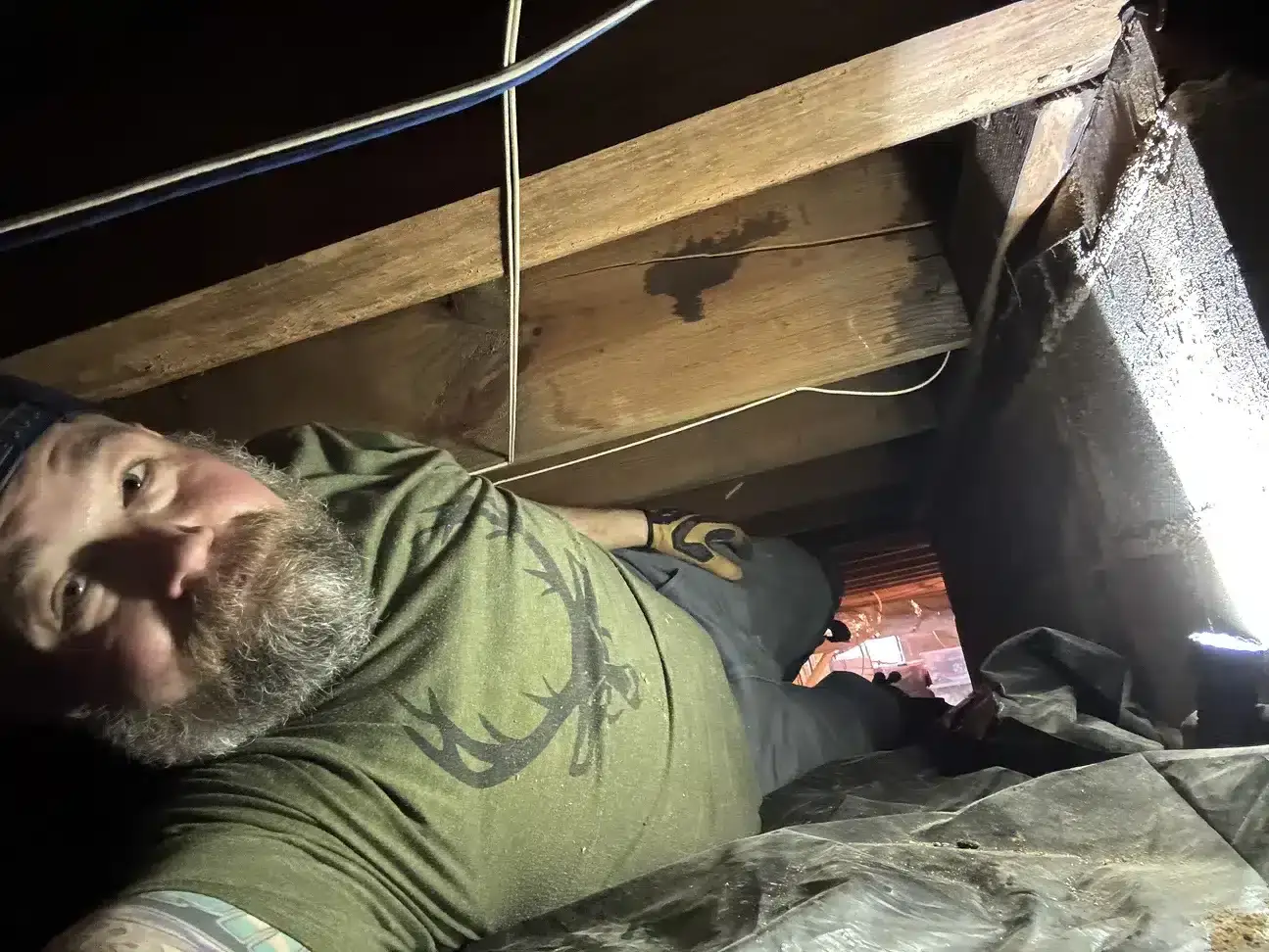
Call if you hear the noise more than one night, if you find droppings or a chewed opening, or if you can’t tell which animal you have. Covenant Pest Services works from our office in Acworth and serves Kennesaw, Marietta, Woodstock, Canton and the rest of North Atlanta. A wildlife visit starts with an inspection of the roofline, attic and exterior to identify the animal and every way in. From there it is usually a mix of humane trapping, sealing the entry points and, where it helps, changing what drew the animal in.
Attic Noise FAQ
What animal scratches in the attic at night?
Most often mice, rats, flying squirrels or bats, according to UGA Extension. Raccoons and opossums are also active at night.
Is it squirrels if I only hear it during the day?
Probably gray squirrels. UGA Extension says attic noise during the day could be gray squirrels, while flying squirrels are active at night.
Will the animal leave on its own?
Don’t count on it. An attic is warm, dry and safe from predators, and the opening is still there. As long as it is, something can use it.
Do ultrasonic repellers work in an attic?
UGA says sound has almost no effect on repelling rats and mice.
Can I seal the hole myself?
You can seal small gaps around pipes and cables. Don’t close a hole an animal is actively using until you are sure it is out, and leave bats to a professional.
How do I tell mice from rats?
Check the droppings. UGA says mouse droppings are about the size of rice grains and rat droppings about the size of raisins.
Hearing something overhead tonight? Call (678) 820-6848 or request an estimate online.